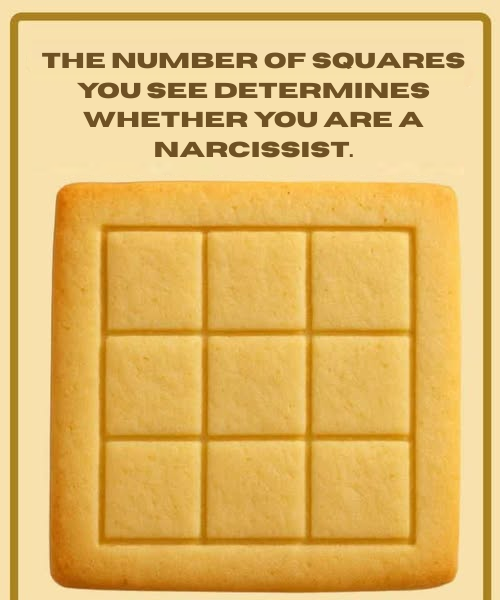
At first glance, this simple, cookie-like image seems harmless—just a grid carved in dough. But the question above it, “The number of squares you see reveals whether you’re a narcissist,” makes everyone stop and think. It’s an entertaining psychological illusion that went viral online, sparking thousands of discussions. Let’s explore what this puzzle really says about your thinking, your powers of observation, and—yes—whether a few narcissistic traits might be lurking beneath your calm exterior.
Step one: Count the squares
Take another look.
You’ll probably see nine small squares at first. But if you look longer, you’ll spot larger ones: the four that form from piecing together smaller sections, and finally, the one large square that contains them all. In total, there are 14 squares—if you’ve counted them all, congratulations! You have a good sense of pattern and a keen eye for structure.
Step one: Count the squares
Take another look.
You’ll probably see nine small squares at first. But if you look longer, you’ll discover larger ones: the four that form from piecing together smaller sections, and finally, the one large square that contains them all. That makes 14 squares in total—if you’ve counted them all, congratulations! You have a good sense of pattern and a keen eye for structure.
According to playful “pop psychology” on the internet, the number of squares that immediately catch your eye can say something about you:
6–8 squares: You’re uncomplicated and don’t overthink everything. You notice the obvious and move on. Perfectionism and a need for control are less important to you.
9–11 squares: You’re analytical and meticulous. You enjoy solving problems and thinking deeply, but you still manage to balance logic and intuition.
12–14 squares: You see things that others miss. You’re a perfectionist, a stickler for detail—and, in keeping with the meme’s ironic undertone, perhaps a bit egocentric or controlling. In other words, the label “narcissist” here is a joke about how closely you analyze yourself and your environment.
Why this image feels so apt
This test isn’t scientific – it’s more for self-reflection. Essentially, it measures perceptual style. Some people process information globally (they grasp the big picture first), while others focus on details before considering the overall context. The joke about narcissism plays on the idea that people who look too closely also tend to overthink their appearance or performance.

In psychology, narcissism has nothing to do with how many squares you count. But your reaction to the challenge can be revealing. Were you proud of finding all 14? Were you annoyed that others didn’t see as many? Or did you take it in stride? This reaction says more about your mindset than the number itself.
The Hidden Lesson Behind the “Square Cookie Test”
This viral puzzle works because it’s simple yet symbolic. The squares can represent how we divide our lives—work, family, health, goals, dreams. Some people only see a few areas clearly, while others recognize the connections. Both are valuable. It’s not about judging yourself, but about recognizing how our brains naturally organize the world.
When you stop seeing only lines and shapes and start thinking about meaning, you demonstrate curiosity—one of the strongest signs of intelligence and emotional balance at any age.
So… Are you a narcissist?
Probably not.
But you’re curious enough to question what you see. That curiosity is healthy. It means you’re open to learning more about yourself—and that’s the opposite of narcissism.
Next time you scroll past a viral “thinking test,” don’t take it literally. Instead, enjoy the mental exercise. It’s not about diagnosing your personality, but about figuring out how you interpret patterns, details, and the world around you.
So, how many squares did you find? 👀